
IPTV in Brazil: How Smart Sports Streaming Protects Your Wallet and Your Weekend
If you have ever audited your household budget the way you audit an investment portfolio, you already know the uncomfortable truth: subscription creep is real. Cable packages, streaming add-ons, sports tiers, and "premium" bundles quietly compound against you month after month, delivering a negative return on entertainment spend that most families never stop to calculate.
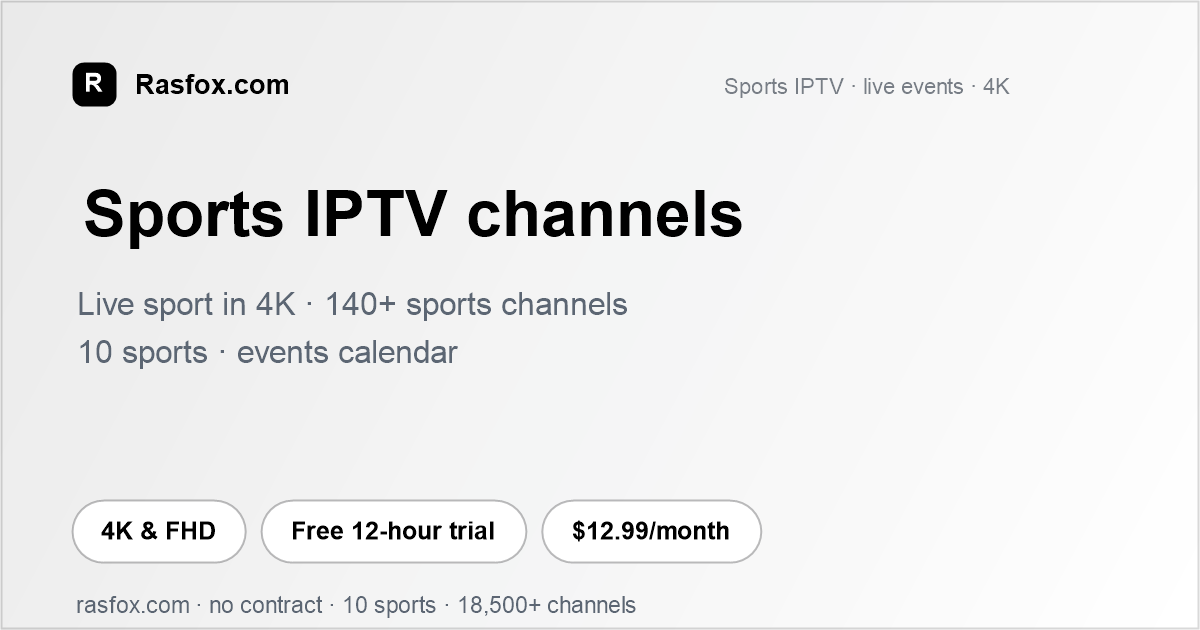
For sports fans in Brazil, the problem is sharper than almost anywhere else. Football is not a hobby here — it is a weekly ritual, and the broadcasters know it. That is exactly why a smarter category of streaming has emerged, one that treats live sports as the core product rather than a premium add-on. This is where IPTV enters the conversation, and where a sports-first provider like RasFox changes the math entirely.
The thematic bridge is simple: investing is about cutting waste, controlling recurring costs, and allocating capital toward what actually delivers value. IPTV does all three — for your household budget and for your football weekends.
What Is IPTV and How Does It Transform Live Sports?
IPTV stands for Internet Protocol Television. Instead of receiving channels through a satellite dish, a coaxial cable, or an over-the-air antenna, IPTV delivers television content as data packets over your existing internet connection.
The practical difference is enormous. Traditional cable is a linear system: the broadcaster decides what plays and when, and you pay for hundreds of channels you will never open. IPTV is on-demand and channel-rich — you choose what to watch, when to watch, and increasingly, at what quality.
For sports specifically, the transformation is dramatic:
- Full match libraries on demand — rewatch a derby at midnight, not just when the replay slot allows.
- Multi-competition access — Brasileirão, Libertadores, Champions League, Premier League, La Liga, F1, and UFC in a single interface.
- Higher picture quality — modern IPTV delivers 4K at 50FPS, which is critical for fast-motion sports like football and Formula 1.
- No installation visit — no technician, no dish, no drilling, no 12-month lock-in.
From a financial perspective, this matters because the cost structure is fundamentally different. Cable operators carry heavy infrastructure — satellites, field crews, set-top box logistics. IPTV providers route content over infrastructure that already exists. That efficiency flows to the subscriber.
The Investor's Angle: How IPTV Improves Your Household Budget
Let us treat your household like a small business for a moment. You have fixed costs, variable costs, and a discretionary bucket. Cable TV in Brazil typically sits in the fixed-cost column — and that is the worst place for an expense that delivers declining value.
Consider the expense ratio. A full cable package with sports tiers in a major Brazilian city can easily run several hundred reais per month. Over five years, that is a genuinely significant sum — money that could be sitting in a Tesouro Direto position, a CDB, or an index fund, working for you instead of for a broadcaster's shareholder report.
The core insight: every recurring expense you eliminate does not just save the monthly amount — it frees capital that compounds. Cutting R$250 a month and redirecting it to an instrument yielding 10% annually produces a meaningfully different outcome over a decade than simply leaving it in a cable contract.
This is where a sports-focused IPTV service becomes a genuinely rational financial decision rather than just a cheaper toy. Providers built around live sports — like the best IPTV service for Brazilian football fans — bundle the one thing you actually pay for (live matches) with a broad channel catalogue, at a fraction of the legacy cost.
A Quick Cost-Benefit Checklist
- Contract risk: Cable = 12-month lock-in with cancellation penalties. RasFox IPTV = no contract, cancel whenever.
- Channel waste: Cable = 400 channels, 90% unused. IPTV = 12,000 channels, you pick your bouquet.
- Quality: Cable HD is often compressed. IPTV offers 4K 50FPS for live sport.
- Trial before commitment: Cable = none. IPTV = 24-hour free trial.
If you approach your entertainment spending the way you approach any other line item — with skepticism, spreadsheets, and a bias toward value — the conclusion tends to write itself.
Deep Dive: The IPTV Landscape in Brazil
Brazil is, in many ways, an ideal IPTV market. Fibre-to-the-home coverage has expanded aggressively across state capitals and mid-sized cities, average connection speeds have climbed steadily, and mobile data is abundant. The infrastructure that IPTV depends on is no longer a constraint — it is a competitive advantage.
At the same time, the traditional pay-TV market has been contracting. Subscribers have been leaving legacy operators for years, frustrated by rigid bundles, rising prices, and the fragmentation of sports rights across multiple platforms. Rights to major competitions are now split between several broadcasters, which means a fan who wants full coverage often needs more than one subscription.
IPTV sidesteps that fragmentation. Instead of stacking three or four separate apps and logins, you get one interface with the full slate.
The Sports Channels That Matter in Brazil
A serious IPTV service for Brazilian viewers must carry the channels that actually broadcast the games people care about. On a sports-first platform, you should expect:
- Globo — the traditional home of free-to-air football coverage.
- SporTV — the deepest domestic football coverage in the country.
- Premiere — the pay-per-view engine of the Brasileirão.
- ESPN Brasil — international leagues, analysis, and live events.
- BandSports — a broad multi-sport portfolio.
- Combate — the home of UFC and combat sports in Brazil.
- TNT Sports BR — Champions League and elite European football.
Beyond domestic channels, a proper sports-focused IPTV package should reach internationally: ESPN, DAZN, Fox Sports, beIN Sports, Sky Sports, and Eurosport. That combination unlocks the Brasileirão, Libertadores, Champions League, Liga Portugal, Liga Argentina, La Liga, Premier League, F1, and UFC — all from one subscription.
Radio Malena and the Latino Sports DNA Behind RasFox
There is a detail about RasFox that says a lot about its philosophy. The operation traces its roots to Radio Malena 89.1 FM in Buenos Aires, at Venezuela 370 — a station steeped in tango, Argentine culture, and the region's deep broadcasting tradition. That lineage is not marketing decoration. It explains why the platform is built by people who understand live sports culture in Latin America, and why the service is engineered for lusophone and Latino audiences worldwide rather than as a generic global product.
In practical terms, that means:
- 12,000 live channels covering Brazil, Portugal, Argentina, and the wider world.
- 40,000+ titles of VOD in 4K 50FPS.
- 2 simultaneous screens — so the family can split between the match and a series.
- No buffering on properly configured connections, backed by sports-grade server capacity.
- Support in Portuguese and Spanish, from people who actually watch the games.
- No contract and a 24-hour free trial before you commit a single real.
For a Brazilian football fan, that combination is close to the ideal configuration: domestic channels, international reach, and infrastructure tuned for 90 minutes of uninterrupted live action rather than a generic streaming catalogue.
Hardware and Setup Guide for Brazilian Viewers
One of the most common objections to IPTV is technical anxiety. In reality, the setup is simpler than configuring a broker app on your phone — and considerably cheaper than a cable installation visit.
What You Need
- A stable internet connection. Around 10 Mbps for HD, 25 Mbps or more for 4K sports streams. Fibre is ideal.
- A streaming device. Amazon Fire TV Stick, Android TV box, Chromecast with Google TV, Apple TV, or a smart TV with a native IPTV app.
- A subscription from a provider that supplies an M3U link or an app login.
Setup Steps
- Connect your device to your home Wi-Fi — ideally the 5 GHz band — or better, use an Ethernet adapter or cable.
- Install the recommended IPTV player app from your device's app store.
- Enter the credentials or playlist URL provided by your provider.
- Let the channel list load, then organise your favourites — Brasileirão, Libertadores, and Champions League at the top.
Pro tip for financial planners and analysts who travel: IPTV is location-flexible. A Fire Stick in a hotel room in São Paulo or a laptop in Lisbon can access the same subscription, which is useful if you spend time between markets. If you want a solution that works across devices and geographies without juggling multiple subscriptions, RasFox's multi-device IPTV setup is designed exactly for that scenario.
One more efficiency note: if you are already paying for high-speed internet for work, trading platforms, or remote meetings, the marginal cost of adding IPTV is close to zero. You are simply using bandwidth you already purchase.
Legal vs Illegal IPTV: Safety, Risk, and Best Practices
This is the section most articles either skip or handle carelessly, so let us be direct. IPTV as a technology is entirely legal. What determines legality is licensing — whether the operator has the right to distribute the content it carries.
The Risks of Unlicensed Services
- Malware and data theft. Free or ultra-cheap services are frequently funded by injecting ads or harvesting user data.
- Sudden shutdowns. Regulators in Brazil and across Latin America periodically take enforcement action against pirate operations. When that happens, subscribers lose everything overnight — with no refund.
- No support. When a stream freezes during a Libertadores semi-final, there is nobody to call.
- Payment exposure. Handing card details to an anonymous operator is a straightforward financial risk.
What to Look For in a Legitimate Provider
- Transparent pricing and clear contact channels.
- Human support in your language.
- A free trial period — reputable services offer one because they are confident in the product.
- No contract requirement.
- Independent payment processing rather than direct transfers to a personal account.
RasFox positions itself in the legitimate, service-first category: a sports-focused IPTV solution with a 24-hour free trial, no lock-in contract, and Portuguese and Spanish support. Testing before paying is not just good practice — it is the single most reliable filter between a professional service and a risky one.
Frequently Asked Questions
Is IPTV legal in Brazil?
IPTV technology is legal. Legality depends on whether the provider holds distribution rights for the content it streams. Licensed, professionally operated services are legitimate; unlicensed operations that redistribute premium content without rights are not, and they carry real risks for subscribers.
How much internet speed do I need for IPTV in 4K?
Around 10 Mbps is sufficient for HD. For 4K at 50FPS — the quality level you want for live football and Formula 1 — plan for 25 Mbps or more, with a stable fibre connection and preferably a wired or 5 GHz Wi-Fi link.
Can I watch Brasileirão and Champions League on IPTV?
Yes. A sports-focused IPTV service carries channels such as Globo, SporTV, Premiere, ESPN Brasil, BandSports, Combate, and TNT Sports BR, plus international outlets like ESPN, DAZN, beIN Sports, and Sky Sports — covering the Brasileirão, Libertadores, Champions League, Premier League, La Liga, F1, and UFC.
How many devices can I use at once?
RasFox supports two simultaneous screens, which is ideal for households where one person wants the match and another wants a film. Additional devices can typically be connected, with only two active streams at a time.
Is there a free trial before I subscribe?
Yes — a 24-hour free trial is available, with no contract and no obligation. It is the most practical way to verify stream stability during a live match before committing.
Conclusion: Treat Your Streaming Budget Like an Investment
The logic here is not complicated. You already apply discipline to your portfolio: you question fees, you avoid lock-ins, you demand evidence before committing capital. Your entertainment spending deserves the same scrutiny — especially when cable operators in Brazil have spent years testing how much fans will tolerate.
IPTV, and specifically a sports-first platform built by people with genuine Latin American football culture behind them, offers a rare combination: more content, better picture quality, no contract, and a materially lower monthly cost. The savings are real, and redirected properly, they compound.
If you want to see it working — live, in 4K, during an actual match — start with the 24-hour free RasFox trial. Watch a Brasileirão fixture, check the stream stability, compare it against your current bill, and then decide. That is the same evidence-based approach you would apply to any other investment. Your weekend — and your budget — will thank you.